Showing posts with label The Goonies. Show all posts

Thursday, 23 April 2015

What Writers Can Learn from the Movies

I'm a writer, so this is a tough thing to admit - I have a guilty secret:

If I had some time to fill and my choice was a movie, or a book, I'd probably choose a movie.

I love books, of course I do, I love the texture, smell and look of a book. I love their immersive quality and the fact that everyone who reads a book has a different experience because the movie is playing out in their head.

For years I held on to this secret when talking to other writers and readers.

All the advice says writers should read a lot. I agree, to a point, and I do love a good book. But I still felt inadequate when writers name dropped hundreds of authors I've never heard of and all the books they've read.

Many writers use it as a badge of honour, sharing their list of books with much haughtiness, as if they deserve a medal for it.

But being a good writer is not just about all the books you've read and authors you can name drop, it's about being able to tell a good story.

For me, writing is not about stringing lots of flowery words together, but telling a compelling story. It just so happens that writing is the best way I know to convey my stories.

The power movies have over books is that they are a quick and easy way to consume a story without devoting too much time and thought to it.

Ultimately, that's what it's about - they are just different mediums to consume a story and what I really love is stories.

Movies are short stories.

Box sets are books. They too are a series of smaller stories that form a more complete narrative.

Stories should move you, stories should get your heart racing and your imagination singing (Tweet this)

Writers can learn a lot from movies. Here's the good, the bad and the ugly of wrting tips learned from the movies:

The Good


  • Don't linger in a scene longer than necessary. Keep it moving.

  • Less is more. Give the readers a snapshot. Tell us volumes about a character in a single scene, mannerism or action.

 The Bad


  • Avoid the cliches. Why are baddies always terrible shots? Why does the baddie tell the hero his entire plan in the mistaken belief that their elaborate contraption to kill him will work?


  • They don't all have to live happily ever after.

  • The hero doesn't always have to get the girl  

  • Women are portrayed as weak, damsels in distress far too often in movies. Change the page people, it's the 21st century!

The Ugly

  • Don't shy away from powerful, disturbing or controversial scenes. 
If a sex scene is an important turning point in a relationship between characters, describe it - get your readers crossing their legs and biting their lips as they immerse themselves in the scene. 
If your bad guy is a sicko that leaves a gory mess in their wake, embrace the gore.

If your bad guy holds some extreme views, help us to understand their point of view, even if we fundamentally disagree with their values.


Inevitably, writers are influenced by other writers and their style. 

For me, the top three authors I admire and whose style influences me the most are:

Kate Mosse


Stephen Leather


Paul Sussman


But, if I'm honest, I'm probably more influenced by movies and box sets. They are a visual feast, and the challenge for me as an author is to convey the action and experience of the big screen into text to give my readers a movie like experience.


When I write, the scenes play out in my head like the episodes in a box set, I 'see' my characters and their story and I want to transmit those images into the brains of my readers.

I use movie references to describe what the books are about:

'Indiana Jones, meets Bourne - but with a female lead'(Tweet This)


Here are the top 10 movies that have influenced the action/adventure genre where The Bronze Box and Solomon's Secrets fit.

These are movies from my childhood or that first ignited my passion for stories and more recent movies that inspire my stories:

  1. Indiana Jones - Raiders of the Lost Ark
  2. Indiana Jones - The Temple of Doom
  3. Indiana Jones - The Last Crusade
  4. The Bourne Identity
  5. The Goonies
  6. Labyrinth
  7. Ronin
  8. Heat
  9. The International
  10. In Bruges


And here they all are. Every self respecting movie buff needs these in their collection:


What movies have influenced your creativity?

Friday, 6 March 2015

Creating People (no, not like that...)


How to Create Characters

One of the great joys of being a writer is making up new people. We get to play God in the low risk environment of our imaginations and in the process, learn more about ourselves.

My favouite computer game is The Sims (I'm still on Sims 2 and already there's a Sims 4) where I get to be an all powerful deity controlling the life and death of my virtual people. As a writer, I'm doing the same thing in my books.

Create some characters, put them together in a situation, poke them and see what happens.


There's a simple formula that defines a story:


Characters + Conflict = Story

We throw in all sorts of other juicy ingredients to create the layers of flavour needed to keep a reader salivating, but essentially this is what it boils down to.

 Every story needs characters, but how do you conjure up new people?


  • Observation: Observing and understanding other people is crucial to develop believable characters. I'm a fan of people watching, watching strangers going about their lives and creating a story for them based on how they look, behave, dress and speak.


  • People we know: There's a myth that writers base their characters on real people. Sometimes this works, but more often than not we draw inspiration from different aspects of the personalities of the people we know, consciously or otherwise, and create new combinations of features and traits.


  • Research: It's not necessary to be a qualified psychologist to create characters but researching psychology, behaviours, academic studies, personality tests etc. can provide inspiration and help writers to coax realistic emotional responses from our characters when we put them in different situations.


  • Learn from other fiction: Film, TV, Books, Theatre - other fictional characters can have a real impact on our lives. Have you ever cried when a character has died?

I love adventure fiction; a bit of action, a bit of history. That's what I enjoy writing and I'm sure that this developed in me at a young age from the experiences I had as a child.


My favorite movies when I was growing up that influenced this were:

Indiana Jones films (I was in love with Indiana Jones and Harrison Ford was my first crush)


The Goonies


Labyrinth


When developing characters, there's a simple process used by anyone teaching the subject and I've added my own take on it.

 
One of the best known personality profiling tools is the Myers-Briggs Personality Type Indicator test. This profiling tool categorises people broadly into 16 personality types.

If you're not familiar with it, this is a great Wikipedia explanation: 
http://en.wikipedia.org/wiki/Myers%E2%80%93Briggs_Type_Indicator


Use the personality typing questions in this image to determine the personality type of your main characters.


In my Sheridan and Blake Adventure Series I have done this for Tom Sheridan and Sasha Blake


Tom Sheridan: ISTJ (Introvert, Sensing, Thinking, Judging)
He's reserved, a strategist, he struggles to show his emotions, prefers to observe than be the centre of attention - his specialty is hiding in plain sight. He's a logical thinker, loyal, likes to have a plan and scrutinize the details, Sasha calls him 'calculating'.


Sasha Blake: ENTP (Extrovert, Intuition, Thinking, Perceiving)
She's impulsive, argumentative and likes to think out loud. She likes to imagine and consider different possibilities but then pin them down logically, make decisions and solve puzzles. She's spontaneous and fickle but in many ways, despite projecting outward confidence, verging on self righteousness, she is quite insecure and fears commitment.


Once I've made some decisions about the type of person my characters are and what they look like, I find images of actors who could play them in a movie. I collect the images on a Pinterset board, pinning images of the actors in different poses and situations. It helps me to hear tone of voice, imagine and picture scenes.

Here's my Pinterest board for my latest book, Gabriel's Game

Follow Amy Morse's board Gabriel's Game: Characters on Pinterest.  


Actions for writers:

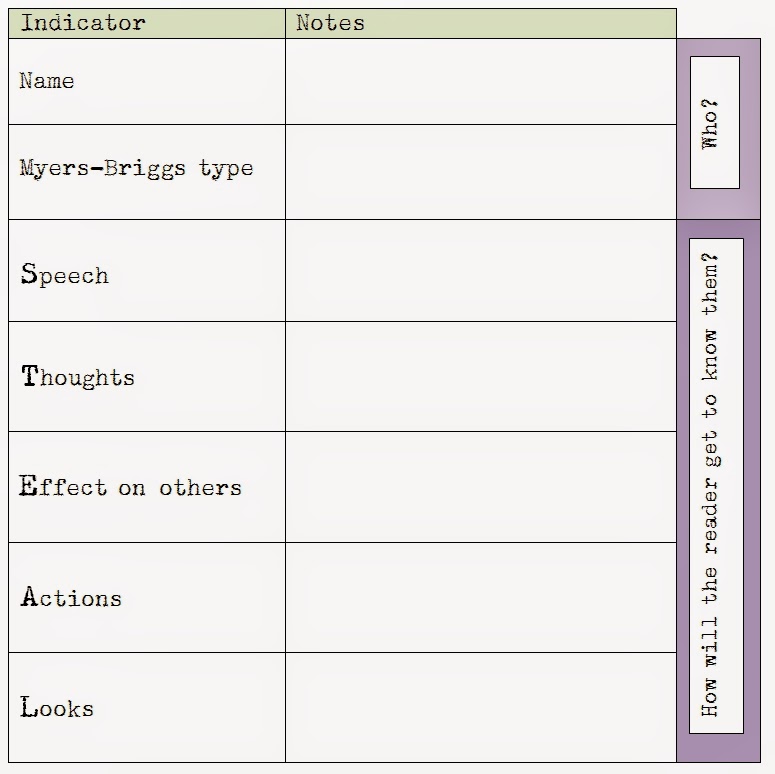
Use this blank proforma to make notes on your main characters and bring them to life on the page:


How do you come up with character ideas?